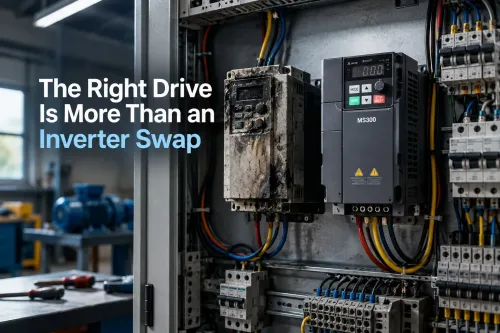


A Delta MS300 drive cannot be selected safely from motor horsepower alone: its usable current depends on the complete model code, voltage class, duty rating, installation conditions, and the motor nameplate amps. By the end, you will be able to read the rating table, compare output current with your motor, account for derating, and prepare a specification for machinery in Vadodara.
Key takeaways
- Choose by motor nameplate amps, not horsepower alone.
- Verify voltage class, phase, frame and duty row in the complete table.
- Derate for Vadodara heat, enclosure temperature and installation conditions.
- Confirm overload capacity against the machine’s acceleration and load cycle.
Read the complete Delta MS300 current-rating table before comparing models
A delta ms300 current rating is not universal: identify the complete model code, frame, input phase, 200–240 V or 380–480 V class, and normal-duty or heavy-duty row before comparing drives. The correct figure is the catalogue’s rated output current for that exact combination, not a value inferred from motor horsepower.
| Model and supply entry | Rated output current | Motor range | Overload class |
|---|---|---|---|
| Every exact MS300 model code and frame | Catalogue amperes | Catalogue kW and HP | Normal-duty or heavy-duty |
| Single-phase, 200–240 V input | Use its model-specific row | Use its listed motor range | Use its stated overload percentage and time |
| Three-phase, 200–240 V input | Use its model-specific row | Use its listed motor range | Use its stated overload percentage and time |
| Three-phase, 380–480 V input | Use its model-specific row | Use its listed motor range | Use its stated overload percentage and time |
These delta ms300 amperage specifications describe rated output current: the current the drive can deliver continuously under the stated conditions. Continuous current is not the same as overload current, which is a higher value permitted only for the specified time. Short-time peak capacity applies for an even shorter transient.
Temporary overload does not permit continuous operation above the catalogue rating.
Read the complete Delta catalogue table for the exact revision and frame; do not combine a 230 V motor row with a 400 V drive row. Also confirm whether the motor duty is normal or heavy duty, because the applicable continuous and overload limits change.
Use motor nameplate amps, not horsepower, to choose the current class
Choose the MS300 current class from the motor nameplate full-load current, not from kW or horsepower alone. Record these details before selecting a model:
- Rated voltage and phase
- Frequency, usually 50 Hz
- Full-load current in amperes
- Motor kW or HP
- Terminal connection, such as star or delta
Compare the nameplate current with the applicable MS300 rated output current in the correct voltage and duty row. The Delta MS300 drive current capacity changes with voltage class and duty selection, so do not compare a 230 V figure with a 400–480 V figure.
| Motor example | What the nameplate shows | Selection decision |
|---|---|---|
| 1.5 kW pump | 230 V, 6.2 A; applicable MS300 rating 7 A | The nameplate current sits below the catalogue rating, so this current class fits if duty and site derating also fit |
| 1.5 kW conveyor | 400 V, 3.5 A; applicable MS300 rating 3.8 A | The margin is narrow; check overload and acceleration, then choose the next larger current class if demand approaches the limit |
| 1.5 kW mixer | 400 V, 4.2 A; applicable MS300 rating 3.8 A | Do not use this class; select the next larger class |
Two motors with identical kW can draw different amps because rated voltage, efficiency, power factor, and star or delta connection differ. A motor close to or above the catalogue current can overheat the drive or trip during acceleration, even when its horsepower appears to match.
Check Vadodara site conditions before accepting the headline amperage
The headline Delta MS300 drive current ratings in Vadodara apply only under the stated voltage, phase, temperature, altitude, and switching conditions. Confirm whether the site supply is single-phase or three-phase, and whether it is approximately 230 V or 400/415 V, before using any amperage figure.
Supply and motor details change the comparison:
| Supply or motor condition | What to verify | Why it matters |
|---|---|---|
| 200–240 V supply | 230 V motor voltage and connection | Use the 200–240 V MS300 class; current is not interchangeable with the 400 V class |
| 380–480 V supply | 400/415 V motor voltage and connection | Use the 380–480 V class and confirm the motor’s star or delta connection |
| Different motor connection | Nameplate voltage, phase, and full-load amps | A 230 V motor and a 415 V motor with identical kW can require different drive current |
Reduce the usable output-current allowance when the installation has any of these conditions:
- High ambient temperature, elevated altitude, restricted airflow, or a small enclosure
- Inadequate panel ventilation, insufficient drive spacing, or several drives heating one cabinet
- High carrier frequency, which increases switching losses and drive temperature
Apply the derating tables in the exact MS300 catalogue or installation manual whenever heat, restricted airflow, elevated installation, or high switching frequency applies. Use motor-side output current to compare the drive with the motor and output conductors.
Size upstream breakers, fuses, contactors, and input cables from the manual and local electrical requirements, not from output current alone.
Match current and overload capacity to the machinery duty cycle
Choose the heavier MS300 current class when the motor’s nameplate amps, acceleration demand, or cycling pattern exceeds normal-duty service. A Delta MS300 current rating is not interchangeable between duty rows: a normal-duty row does not automatically provide the same continuous current and overload performance as a heavy-duty row.
| Application | Usual duty concern | Selection implication |
|---|---|---|
| Pumps and fans | Light, steady load | Normal duty can fit when nameplate current remains comfortably below the rating |
| Conveyors | Constant torque and loaded starts | Compare nameplate amps closely; heavy duty may be required |
| Compressors and mixers | High torque and load inertia | Allow overload margin for acceleration |
| Hoists | Repeated acceleration, braking, and holding torque | Use the heavy-duty specification and verify peak demand |
| Frequent starts and stops | Thermal accumulation | Next larger rating class may be necessary |
Worked comparisons make the choice clearer. A lightly loaded pump marked 6.2 A can suit a 7.0 A normal-duty row if acceleration is gentle and cycling is limited. A conveyor marked 6.8 A on that same row has little margin; choose the next larger class or heavy-duty row when it starts loaded.
A hoist marked 6.5 A that accelerates every 30 seconds needs more than a kW match. Check the heavy-duty overload percentage and duration, then step up if acceleration time is long, load inertia is high, or torque demand causes current limiting. Short-time overload does not increase continuous Delta MS300 drive current capacity.
Build a procurement schedule that prevents the wrong MS300 rating
Send one complete data sheet, not only the motor horsepower, before requesting a drive for a Vadodara machine. For Delta VFD MS300 current details in Vadodara, use this procurement checklist:
- Complete Delta MS300 model code requested or currently installed.
- Incoming supply voltage and phase: single-phase or three-phase.
- Motor nameplate voltage, phase, frequency, and star or delta connection.
- Motor full-load current in amperes.
- Motor rating in kW or HP.
- Application duty: normal-duty or heavy-duty.
- Required overload percentage and duration, such as 150% for 60 seconds.
- Planned carrier frequency in kHz.
- Maximum ambient temperature at the drive location.
- Installation altitude above sea level.
- Enclosure type, panel dimensions, ventilation, filters, and cooling method.
- Number of drives installed in the same panel.
- Duty cycle, including starts, stops, acceleration time, load inertia, and running pattern.
Shree Sahastra Enterprise (Authorised dealer of LU can use this schedule when supplying Delta VFD MS300 drives to business customers, because it exposes derating and overload conditions before the current class is selected.
The buyer remains responsible for confirming motor data, protection design, cable sizing, earthing, upstream breakers and fuses, and installation requirements against the current Delta catalogue and installation manual. A supplier’s quotation does not replace those checks.
Frequently asked questions
What information identifies the correct Delta MS300 current rating?
Check the complete model code, frame, input phase, voltage class, and normal-duty or heavy-duty row before comparing rated output current.
Should you choose a Delta MS300 drive by horsepower or motor amps?
Use the motor nameplate full-load current as the primary selection value. Horsepower is only a preliminary reference because motors with the same horsepower can have different rated currents.
Which Vadodara site conditions affect Delta MS300 drive current capacity?
Check ambient temperature, enclosure temperature, altitude, ventilation, installation clearance, input voltage and phase. Apply the catalogue derating instructions when conditions exceed the stated operating range.
How do you match MS300 current and overload capacity to machinery duty?
Identify the machine’s starting torque, acceleration time, peak load and operating cycle, then compare those demands with the drive’s normal-duty or heavy-duty rated current and overload specification.