

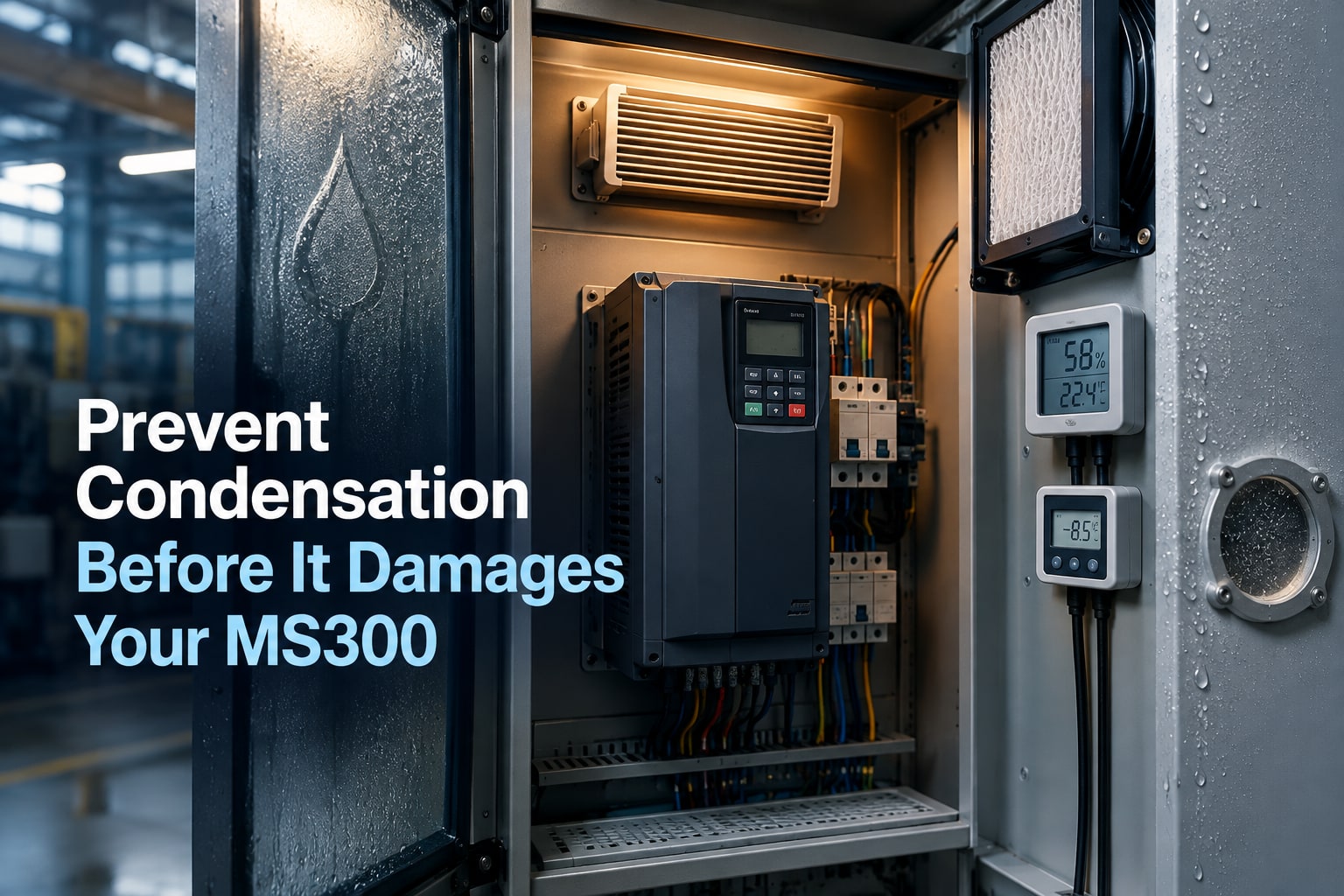
The Delta MS300 is rated for 5–95% relative humidity during operation only when condensation does not occur. By the end, you will know how to measure the real cabinet environment in Vadodara, reduce dew-point risk, inspect moisture damage, and decide when a damp drive is safe to energise.
Key takeaways
- Keep Delta MS300 operation between 5–95% RH with no condensation.
- Measure panel temperature, relative humidity, and dew point—not humidity alone.
- Use heaters, ventilation, and drainage without exceeding the drive’s ambient temperature limit.
- Inspect, isolate, dry, and test the drive after moisture exposure.
What the Delta MS300 humidity rating actually permits
Both apply: the Delta MS300 operating humidity range is 5–95% relative humidity, and operation must remain non-condensing. A reading of 95% RH does not permit mist, droplets, liquid water, or wet cabinet surfaces to reach the drive.
The Delta MS300 humidity requirements are an environmental operating limit, not permission to run the drive in an open enclosure. Install it inside an enclosure that keeps out water droplets, conductive dust, and corrosive contaminants; the enclosure’s IP rating and cable-entry method provide that protection.
Do not copy the 5–95% operating figure into a storage or transport specification. Check the current Delta manual for the exact MS300 frame and revision, then record its stated storage temperature and humidity limits. Operating conditions and logistics conditions answer different questions.
IEC 60068 damp-heat language does not authorise continuous condensation in service. A laboratory test demonstrates performance under a defined test sequence; it does not override the installation limit requiring non-condensing air.
Humidity compliance also does not prove that the drive is correctly sized or protected. Check these separately:
- Ambient temperature and output-current derating
- Altitude and overload duty
- Enclosure heat dissipation
- Conductive dust and corrosive gases
For a Vadodara panel, specify the temperature limits, 5–95% RH non-condensing operation, no direct water spray, enclosure protection, anti-condensation measures, and site dust or chemical exposure. “Suitable for humid conditions” is not technically testable.
How to assess humidity and dew point inside a Vadodara panel
A room reading cannot establish delta ms300 humidity conditions in vadodara. Measure temperature and RH together at the installed drive, then calculate dew point; condensation risk exists when the drive, backplate, cabinet roof, or wiring falls below that dew point, even with RH below 95%.
| Point | Why measure | When |
|---|---|---|
| Near drive air intake | Shows air entering the MS300 before drive heat changes it | Monsoon start, humid shutdown, and startup after a long stop |
| Installation location | Captures the immediate cabinet microclimate | During normal operation and overnight cooling |
| Inside control cabinet | Reveals leakage, air-conditioning effects, and heat buildup | With doors closed, at load, and after shutdown |
| Backplate or cabinet roof | Identifies cold surfaces where droplets can form | When surface condensation is credible |
Do not mount the only sensor at the exhaust. Warmed exhaust air can produce a falsely low RH and dew point, hiding the intake condition. Compare each measured surface temperature with surrounding-air dew point during startup, shutdown, overnight cooling, and monsoon transitions.
Investigate process steam, washdown, leaking cable entries, cabinet placement, and uncontrolled ventilation. Air-conditioning can dry a room while humid air still enters through glands; drive heat can raise cabinet air temperature without warming every metal surface.
An outdoor weather station and room average therefore cannot represent delta vfd ms300 humidity conditions: both miss the enclosed panel’s local temperature cycle and moisture sources.
Controls that prevent condensation without overheating the drive
Keep the drive’s internal surfaces above dew point without trapping its heat. A sealed enclosure with suitable IP protection, correctly sealed cable entries, a low-point drain, and clean filters blocks humid air, but the enclosure still needs a heat-rejection plan.
1. Select the control method for the load. Ventilation removes drive heat, but uncontrolled vents can pull humid monsoon air into the cabinet. Check dew point, filter condition, cabinet pressure, and the MS300’s heat rejection before fitting fans or louvers.
2. Use air-conditioning when the drive operates at high load in a sealed cabinet. Dehumidification or a positive-pressure dry-air purge suits sites where humid air, process steam, or dust makes ordinary ventilation unsafe. Maintain positive pressure and filter the purge air.
3. Fit an anti-condensation heater for shutdowns and cold starts. It keeps internal surfaces above dew point; it does not replace cooling or air-conditioning while the drive is operating and producing heat.
4. Place temperature and RH sensors near the drive intake, not beside warmed exhaust air, which can under-report risk. Add a surface-temperature sensor on the backplate or cabinet roof when condensation is credible.
5. State the purchase requirement precisely: model and revision, minimum and maximum operating temperatures, 5–95% RH non-condensing where applicable, no direct water spray, enclosure IP protection, anti-condensation provisions, and exposure to chemicals or dust.
This specification addresses Delta MS300 industrial site humidity in Vadodara and the actual Delta VFD MS300 humidity conditions rather than relying on “suitable for humid conditions.”
Inspection and safe recovery after moisture exposure
Do not energise a visibly wet Delta MS300 after monsoon exposure, transport, a long shutdown, or condensation. The Delta MS300 operating humidity rating does not make liquid water safe, and Delta MS300 humidity requirements do not eliminate contamination risk.
1. Isolate the drive and enclosure under your site’s electrical safety rules. Apply lockout and verify that no hazardous energy remains.
2. Inspect the enclosure, drive, terminals, filters, and printed-circuit assemblies for water marks, droplets, damp dust films, clogged filters, corrosion on terminals, discoloured metal, chemical residue, tracking, or contamination.
3. Check for chlorine, sulfur compounds, acidic vapours, salt, fertiliser dust, and process gases. These contaminants can damage contacts and circuit boards inside the nominal RH range.
4. Keep power off and allow the drive and enclosure to reach ambient temperature. Dry them only by a controlled method specified in the current installation manual; uncontrolled heat or airflow can spread contamination or create thermal damage.
5. Have a qualified technician inspect electrical connections and perform the appropriate insulation-resistance checks. Interpret abnormal results alongside condensation, dust films, chemical deposits, and repeated humid-dry cycling, because high RH reduces insulation resistance and cycling accelerates leakage paths.
Escalate to a qualified technician or Delta service provider if moisture reached electronics, corrosion is present, insulation results are abnormal, or nobody can confirm the drying history. Do not restore power merely because the outside surface looks dry.
Turning the humidity assessment into a purchase and installation decision
A humidity rating becomes a purchase decision only after you compare the cabinet’s dew point with its coldest surface. “Suitable for humid conditions” is not technically testable because it defines neither the measured environment nor the controls required.
- Record temperature and RH at the MS300 air intake, then calculate dew point. Do not use the room average or outdoor weather-station reading.
- Measure the lowest cabinet surface temperature on the backplate, roof, or wiring area where condensation could form.
- Log Delta MS300 humidity conditions in Vadodara during monsoon startup, shutdown, overnight cooling, and restart after a long stop.
- Inspect conductive dust, fertiliser dust, salt, chlorine, sulfur compounds, process vapour, and washdown exposure. These can damage electronics within the nominal RH range.
- Confirm sealed cable entries, enclosure protection, drainage, heater control, cooling capacity, filter condition, and sensor location. Keep the sensor away from warmed exhaust air.
- Check ambient-temperature and output-current derating, altitude, overload duty, and enclosure heat rejection before approving the model.
Write the specification against the exact MS300 model and manual revision. State the manual’s minimum and maximum operating temperatures, storage temperature and humidity limits, 5–95% RH non-condensing where applicable, no direct water spray, enclosure protection, anti-condensation provisions, and cooling requirements.
Shree Sahastra Enterprise (Authorised dealer of LU can use these measured conditions to help select the Delta VFD MS300, enclosure, installation arrangement, and service support without treating humidity as the sizing criterion.
Frequently asked questions
What humidity does the Delta MS300 permit?
The Delta MS300 operating humidity range is 5–95% relative humidity, with operation remaining non-condensing. Mist, droplets, liquid water, and wet cabinet surfaces must not reach the drive.
How do you assess humidity inside a Vadodara control panel?
Measure relative humidity, panel temperature, and dew point at the drive location. Condensation becomes a risk when a cold surface reaches or falls below the measured dew-point temperature.
How can you prevent condensation without overheating the drive?
Use a correctly sized anti-condensation heater, thermostat or hygrostat control, sealed cable entries, a drain path, and ventilation that does not expose the drive to humid air or exceed its temperature limit.
What should you do after moisture reaches a Delta MS300 drive?
Isolate power, document the exposure, inspect for droplets, corrosion, and contamination, then dry and test the drive under qualified supervision before returning it to service.