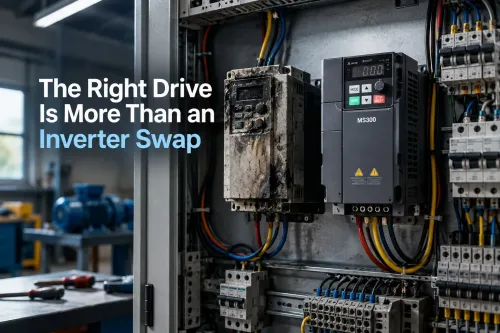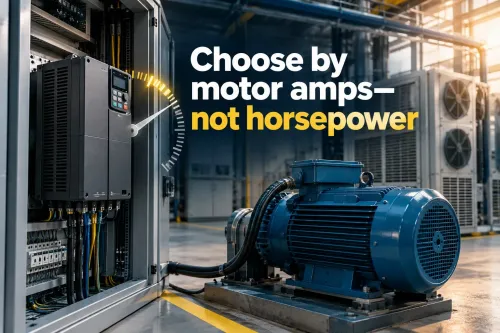

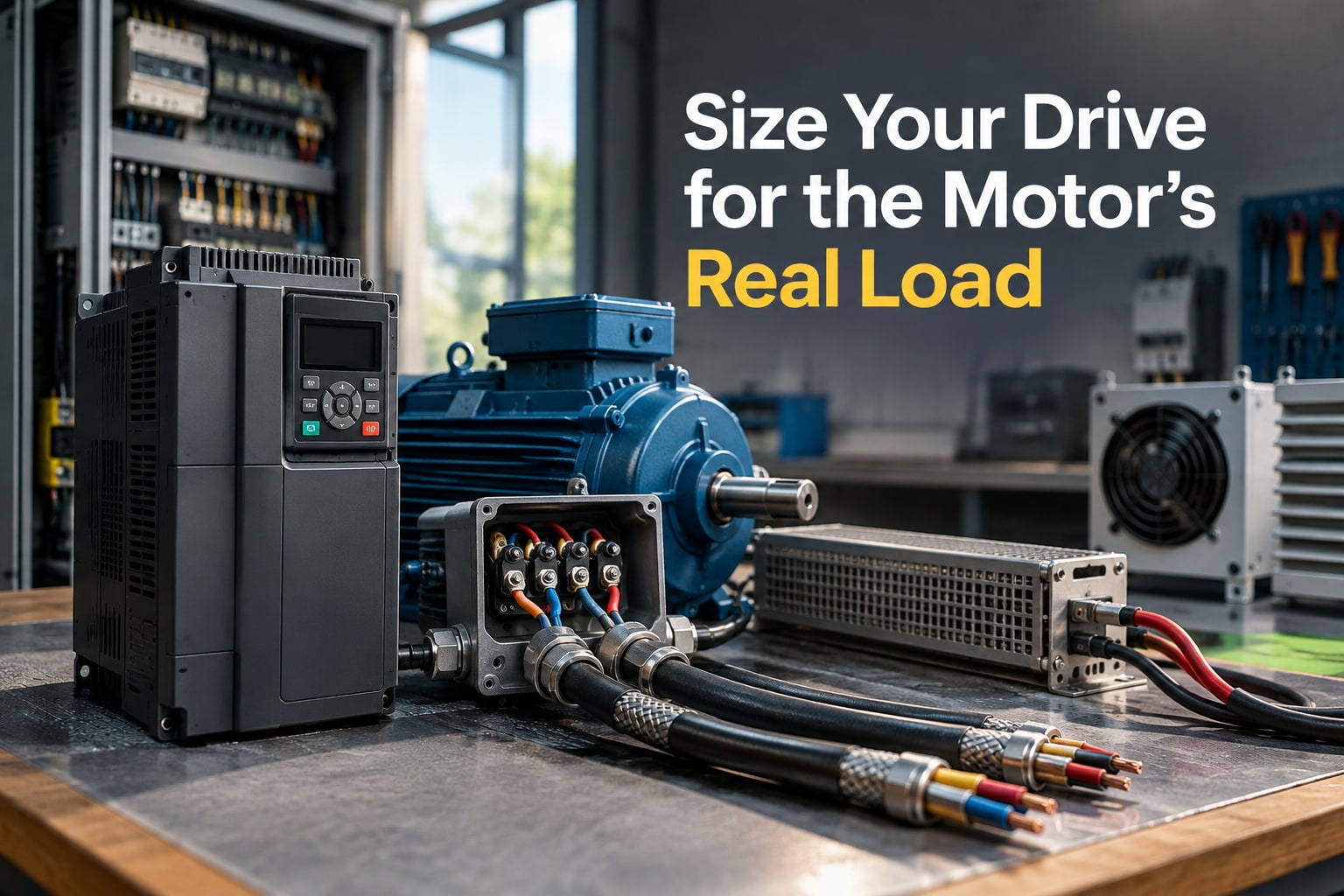
Choose a Delta MS300 from the motor’s nameplate current, supply arrangement and machine duty—not from horsepower alone. By the end, you will have a practical checklist for comparing drive ratings, checking acceleration and braking demands, and identifying installation conditions that can change the correct selection.
Key takeaways
- Record motor voltage, full-load current, frequency and power from the nameplate.
- Choose the MS300 by motor current and duty, not horsepower alone.
- Check torque, acceleration, braking resistor, cable length and panel temperature.
- Document site supply, motor data and selection assumptions before ordering.
Start with the motor nameplate and Vadodara site supply
Collect the motor nameplate and site-supply data before selecting a Delta MS300 drive. For Delta MS300 drive sizing in Vadodara, record:
- Rated voltage, full-load current, power in kW or HP, frequency and rated speed
- Power factor, efficiency, insulation class and connection symbol
- Required delta or star connection at the drive’s output voltage
A 230/400 V motor is not interchangeable with a 400 V motor because both have the same kW rating. Connecting the windings incorrectly can cause under-fluxing, overcurrent or motor damage.
| Site supply | What to verify | Why it matters |
|---|---|---|
| 230 V single-phase | Permitted MS300 input phase and derating table | Input current and thermal limits can be higher |
| 230 V three-phase | Model voltage and phase specification | Confirms the correct drive class |
| Approximately 415 V three-phase | Input range and motor connection | Prevents incorrect voltage selection |
The drive output remains a three-phase motor supply. Check the selected MS300 model’s permitted input phase and voltage, then record the required operating speed and frequency, including low-speed operation below base speed or operation above base frequency.
Also document ambient and panel temperature, enclosure size, ventilation, altitude and the number of drives installed together. Apply the manufacturer’s altitude derating table above its reference altitude. These facts define the real selection envelope before you compare catalogue kW values.
Use full-load current and duty rating for MS300 drive size selection
Size the Delta MS300 from the motor’s full-load current at the intended voltage, not from its horsepower line. The drive’s continuous output-current rating must meet or exceed the motor nameplate current. Motors with the same kW rating can draw different current because efficiency, power factor, frequency and winding design differ.
For practical MS300 drive size selection:
- Read the motor nameplate current at the actual connection and supply voltage.
- Identify the application duty before comparing ratings.
- Compare the motor current with the MS300 output-current rating for that exact duty class.
- Apply the manufacturer’s derating table for ambient temperature, installation conditions or input phase.
| Duty class | Typical application | Selection basis |
|---|---|---|
| Normal duty | Fan or pump within its expected load range | Compare current with the normal-duty continuous and overload ratings |
| Heavy duty | Hoist, mixer, extruder, crusher or heavily loaded conveyor | Use the heavy-duty ratings; do not borrow a higher normal-duty figure |
| Variable torque | Centrifugal fan or pump | Check running current, starting load and abnormal conditions such as blocked filters |
| Constant torque | Conveyor, mixer, compressor or hoist | Allow for sustained torque and acceleration current |
Choose the next larger frame when the motor current exceeds the required rating, overload margin is inadequate, or derating reduces the usable rating below the motor current. Do not oversize without a reason: cost rises without guaranteed control improvement, while motor voltage, current, frequency and protection settings still need accurate programming.
Record the motor voltage, full-load current, duty class, drive output current and the reason for any frame increase.
Match the drive to torque, acceleration and operating speed
Load type changes required MS300 size because torque demand, acceleration and speed range—not motor kW alone—set the duty. For MS300 drive size selection, classify the machine before choosing normal-duty or heavy-duty ratings. How to size Delta MS300 starts with current at the intended duty rating.
| Load category | Torque behaviour | Sizing consequence |
|---|---|---|
| Constant torque | Conveyors, mixers, compressors, hoists, extruders and crushers need substantial torque across the speed range. | Check heavy-duty current, starting torque and low-speed cooling. |
| Variable torque | Fans and centrifugal pumps need less torque as speed falls, reducing running power at low speed. | Avoid unnecessary oversizing, but protect against blocked filters, abnormal hydraulic conditions and difficult starts. |
| Overhauling or high inertia | Hoists, vertical axes, centrifuges and rapid-stop machines can demand braking torque or return energy. | Check braking hardware, torque holding and safe-stop design. |
Before finalising the drive, record:
- Starting torque and acceleration time
- Stopping time and cycle frequency
- Number of starts per hour
- Required operating speed and frequency
- MS300 overload-current capability for the selected duty
A steady-running motor can still trip on overcurrent during acceleration. Sensorless vector control does not remove the need to verify current and torque, or to set a ramp long enough for machine inertia.
Below base frequency, constant-torque work needs adequate low-speed torque and motor cooling. Above base frequency, available torque falls in the constant-power region, so a kW-only choice can fail during low-speed heavy work or extended overspeed. For hoists, include the mechanical brake and torque-holding method; a VFD alone is not a load-holding or personnel-safety system.
Check braking, cables, EMC and panel conditions before ordering
Rapid stopping does not become safe merely because the MS300 has a higher kW rating. High-inertia fans, centrifuges, decelerating conveyors and overhauling loads can return energy to the DC bus, so check whether a braking resistor or braking unit is needed.
- Confirm the resistor’s resistance value, wattage, duty cycle and compatibility with the selected drive and braking unit.
- Check motor-cable length, motor insulation, carrier frequency and reflected-wave risk. Long cables and high carrier frequency increase leakage current and insulation stress; the installation may need screened cable, correct earthing, an output reactor or a manufacturer-approved motor filter.
- Assess input harmonics and power quality before deciding whether the supply needs a line reactor or input choke.
- Size panel ventilation for ambient temperature, drive heat loss, spacing and nearby equipment. Apply the manufacturer’s altitude derating table above its reference altitude.
- Separate motor and control wiring, terminate cable screens correctly and provide EMC bonding at the panel.
- If bypass operation is required, interlock contactors so the drive output is isolated before switching. Never change an output contactor while the inverter is running.
| Installation detail | Practical consequence | Check before ordering |
|---|---|---|
| Cable and EMC | Leakage, insulation stress or interference | Screen, earth, reactor or approved filter |
| Braking duty | DC-bus overvoltage or slow stopping | Resistor value, wattage and duty |
| Panel conditions | Thermal trip or derated output | Temperature, spacing and altitude |
| Supply quality | Harmonic or input-current problems | Line reactor or input choke |
For delta ms300 drive sizing in Vadodara, treat these as application decisions rather than automatic instructions for every MS300 installation.
Turn the sizing review into a documented local selection
Verify the final choice against a one-page record, not a catalogue horsepower line. For delta vfd sizing help in vadodara, attach the motor nameplate photograph and record the measured site supply, because nominal 415 V can sag under load.
- Record voltage, delta/star connection, full-load current, kW or HP, frequency, speed, load type, starting torque, acceleration and deceleration times, cycle frequency, braking requirement, supply phase, cable length, panel temperature, enclosure, altitude and required protection.
- Mark normal-duty or heavy-duty assessment. Confirm the exact voltage-class model, permitted input phase, output phase and every applicable manufacturer derating table, including single-phase input, temperature, altitude and grouped-drive conditions.
- Ask for the proposed model’s output-current calculation, duty basis and accessory list: braking resistor, reactor, choke, filter, screened motor cable and output reactor where required.
| Check | Normal-duty | Heavy-duty |
|---|---|---|
| Current basis | Compare motor full-load current with continuous output current for normal duty | Compare motor full-load current with continuous output current for heavy duty |
| Overload check | Confirm the published normal-duty overload current and duration | Confirm the published heavy-duty overload current and duration |
| Selection result | Increase the frame if derating or overload margin fails | Increase the frame if current or starting torque exceeds the rating |
For delta ms300 drive sizing in vadodara, Shree Sahastra Enterprise (Authorised dealer of LU can use this sheet when reviewing supply and accessories for a business installation. A 230/400 V motor still needs the correct winding connection; a wrong connection can cause overcurrent or motor damage.
Frequently asked questions
What information should you collect before selecting a Delta MS300 drive in Vadodara?
Record the motor nameplate voltage, full-load current, frequency, power, rated speed and power factor, then confirm the Vadodara site supply voltage, phase arrangement and frequency.
How do you select the correct MS300 drive size?
Compare the motor’s full-load current with the MS300’s rated output current for the required duty. Select using current and overload capability rather than motor horsepower alone.
When does the machine need a higher-torque or larger drive?
Review the starting torque, acceleration time, load profile and operating speed. Conveyors, mixers, hoists and other high-inertia loads need a selection that supports their torque and overload demands.
What should you check before ordering the drive?
Confirm braking requirements, motor and control cable lengths, EMC practices, panel temperature, enclosure conditions, ventilation and available mounting space.