
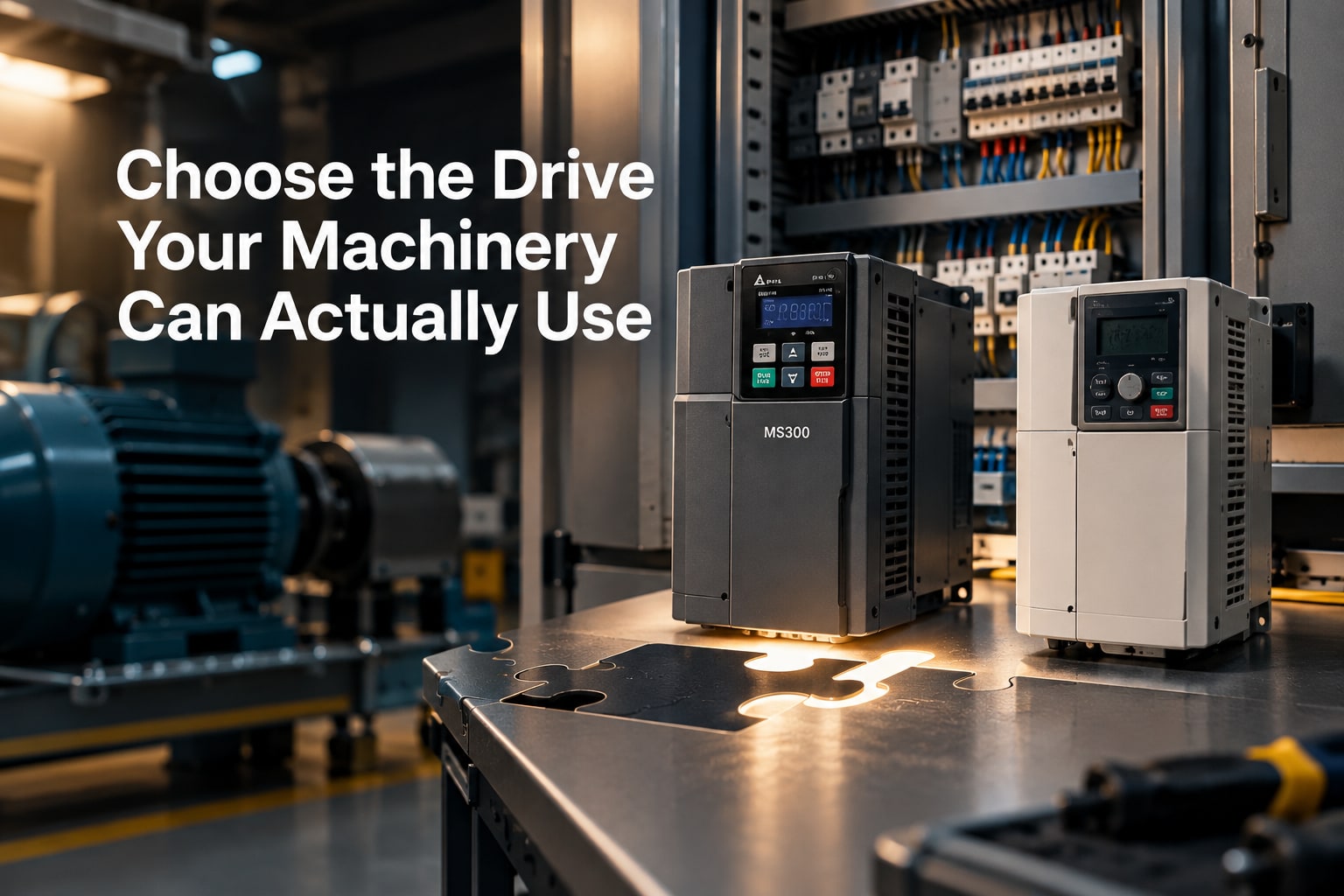
A Delta MS300 cannot be compared fairly with an unnamed Schneider drive: ATV320, ATV340, ATV630 and ATV930 serve different machine and process requirements. By matching the exact model, motor current, overload duty, braking, control, enclosure and supplier terms, you can select a drive that fits the machine rather than choosing by brand or kW label.
Key takeaways
- Name the Schneider series, suffix, voltage class and rating before comparing prices.
- Match the drive to motor current, overload duty, speed range and braking demand.
- Check control terminals, safety functions, communications and panel dimensions against the existing design.
- Give suppliers a specification covering motor data, environment, accessories and commissioning requirements.
Start with the exact Schneider series, not the brand name
ATV320 is one Schneider series; ATV340, ATV630 and ATV930 are different product families aimed at different duties. Therefore, a Delta MS300 versus Schneider drives in Vadodara comparison is invalid until the Schneider series, catalogue suffix, voltage class and exact rating are named. “Schneider VFD” is a brand label, not a technical specification.
| Series | Typical role | Why the comparison changes |
|---|---|---|
| Delta MS300 | Compact general-purpose machine drive, about 0.1–22 kW | Relevant for conveyors, fans, pumps, packaging machines and similar equipment |
| Schneider ATV320 | Compact machine drive, about 0.18–15 kW | A closer small-machine comparison, but current and overload ratings still need matching |
| Schneider ATV340 | Higher-performance machine applications | Control capability, braking and sizing criteria differ from ATV320 |
| Schneider ATV630 or ATV930 | Process or advanced drive applications | Comparing either with an MS300 can be unsuitable for the machine’s duty |
Ask for the complete Schneider code, not merely “ATV320,” because suffixes identify voltage, power, EMC configuration and other construction details. Then compare rated output current and overload class, not motor kW alone: power factor, efficiency, ambient temperature and switching frequency change usable capacity. A drive marked for the same motor power can still be undersized.
Match the drive to the machine’s electrical and load duty
Suitability depends on the motor’s rated current, the site supply and the machine’s hardest load event—not motor kW alone. Record the motor nameplate voltage, full-load current, frequency, power factor, speed and connection, then compare those figures with the drive’s continuous output current and overload class.
| Drive option | Electrical fit | Load-duty checkpoint |
|---|---|---|
| Delta MS300 | Compact general-purpose range, roughly 0.1–22 kW | Conveyors, fans, pumps, machine tools and packaging equipment; confirm heavy-start current |
| Schneider ATV320 | Roughly 0.18–15 kW for compact machine applications | Compare its exact suffix, continuous current and overload rating with the MS300 |
| Schneider ATV340 or ATV630 | More suitable comparison for larger machinery or advanced machine/process duty | Check braking, torque control, feedback, enclosure and process functions |
For a delta ms300 vs schneider vfd decision, check these specifications before accepting a quotation:
- Confirm single-phase or three-phase input, actual 415 V range, phase-loss response, short-circuit rating and permitted mains imbalance. A “400 V” label alone does not prove site compatibility.
- Match continuous current and overload duration to acceleration, jams, hoisting, compressor starts or conveyor loading. A same-kW drive can have a different current rating.
- Specify maximum output frequency, control method, braking resistor duty and stopping time.
- Check ambient temperature, panel enclosure, switching frequency and derating.
- State whether the supply is grounded or IT, whether the EMC filter is integrated, and whether cable length, shield termination or a line reactor changes the installation.
- Name the required interface: RS-485/Modbus does not guarantee EtherNet/IP, EtherCAT, CANopen or PROFINET.
Use a datasheet checklist for control, safety and braking
Compare the datasheet, not the kW label. A Delta MS300 and an ATV320, ATV340, ATV630 or ATV930 can share a voltage class yet differ in current capacity, control functions and safety hardware.
| Specification | Compare in both datasheets | Why it changes the choice |
|---|---|---|
| Rated output current and overload | Continuous amps, overload percentage and duration | A same-kW motor can need a higher-current drive because of power factor, efficiency, duty or switching frequency |
| Control | V/f, sensorless vector, closed-loop option, output-frequency range and autotuning | Torque response and low-speed stability differ between pumps, conveyors and machine tools |
| Safety | STO availability, terminals and stated SIL or PL rating | A drive without the required Safe Torque Off arrangement can force panel redesign |
| Braking | Internal brake transistor, resistor rating, braking unit, mechanical-brake interface or regeneration | High-inertia, frequent-stop and vertical loads can overheat a resistor or run uncontrolled |
| Communications | RS-485/Modbus, Ethernet, EtherCAT, CANopen, EtherNet/IP or PROFINET support | A basic serial port does not provide native PLC networking |
| Installation | Enclosure arrangement, EMC filter, supply type, cable length, shield termination, line reactor and temperature derating | Grounded and IT supplies, long motor cables and hot panels change the installation |
For a Schneider drive comparison in Vadodara, require these items against the exact catalogue code:
- Input phase, voltage class, output frequency and ambient-temperature derating.
- Braking components sized for the load, not merely a statement that braking is supported.
- Communication option, EMC configuration and replacement availability for that exact code.
Compare commissioning and controls with the existing panel
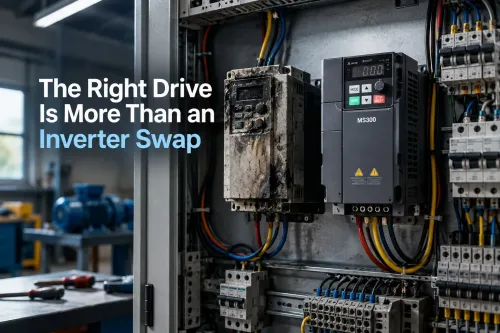
A replacement drive is not a terminal-for-terminal swap. Check the existing panel’s input phases, control-voltage level, terminal logic, braking resistor, EMC arrangement and motor cable before removing the Schneider unit; a mismatch can stop the machine or damage the drive.
| Area | Delta MS300 | Schneider ATV320, ATV340 or ATV630 |
|---|---|---|
| Installation | Compact mounting and model-specific EMC-filter options; verify grounded or IT supply, cable length, shielding and line reactor needs. | Installation, filter and reactor requirements vary by series and catalogue suffix; do not copy ATV320 settings to an ATV630. |
| Programming | Enter motor nameplate data, select V/F or sensorless vector control, then run the specified motor auto-tune. | Enter equivalent motor data and repeat Schneider’s tuning routine; parameter numbers, terminal assignments and ramp settings differ. |
| Panel controls | Map start, stop, reset, speed reference and fault relay to MS300 terminals. Its built-in PLC can handle simple interlocks and delays. | Re-map terminals and confirm whether the selected Altivar model supports the required onboard logic or needs the existing PLC. |
| PLC integration | RS-485/Modbus does not prove EtherNet/IP, EtherCAT, CANopen or PROFINET capability; check the required option card. | Confirm the exact communication card, protocol and function blocks for the chosen Altivar series. |
For machinery drives in Vadodara, record these commissioning checks:
- Save the old parameter file, motor rotation direction and PLC I/O map before rewiring.
- Test low-speed operation, acceleration, deceleration, fault reset and emergency-stop behaviour without the load.
- Confirm overload response and feedback scaling under the real machine duty, not only during an unloaded trial.
Turn the comparison into a supplier-ready purchase specification
Send suppliers a completed specification, not a request for “a Delta or Schneider VFD.” A Delta MS300 versus Schneider drives in Vadodara quotation is valid only when every technical and supply detail is fixed.
1. State the motor’s kW, rated voltage, full-load current, frequency, power factor, speed, connection, and single-phase or three-phase supply.
2. Name the exact drive family and catalogue code: Delta MS300, Schneider ATV320, ATV340, ATV630, or ATV930. Ask suppliers to quote the voltage class, input phase, rated output current, overload category, and switching-frequency range.
3. Describe the load: conveyor, pump, fan, compressor, machine tool, packaging machine, hoist, or another duty. Give starting torque, acceleration time, speed range, braking frequency, and whether regenerative braking occurs.
4. Specify the control method: keypad, terminals, analogue 0–10 V or 4–20 mA, Modbus RTU, EtherNet/IP, EtherCAT, CANopen, or PROFINET. Require the option-card or gateway part number; RS-485 alone does not provide these networks.
5. State the installation conditions: IP20 panel mounting, enclosure rating, dust and moisture exposure, ambient temperature, altitude, airflow, cable length, EMC filter requirement, and temperature-derating calculation.
6. Require the braking resistor or braking unit specification, input and output reactor requirements, safety functions, PLC compatibility, and replacement procedure.
7. Ask for stock status against the exact code, warranty terms, delivery time, datasheet, wiring diagram, and approved substitute. For machinery drives in Vadodara, Shree Sahastra Enterprise (Authorised dealer of LU can verify whether the quoted code is actually available rather than assuming brand availability means local stock.
Frequently asked questions
Which Schneider drive series should you compare with the Delta MS300?
Start with the exact series: ATV320, ATV340, ATV630 and ATV930 serve different applications. Include the catalogue suffix, voltage class and drive rating in the comparison.
How do you match a drive to the machine load?
Compare motor rated current, overload requirement, starting torque, speed range, duty cycle, braking demand and the machine’s supply voltage. Select the drive from motor current and application duty rather than motor horsepower alone.
What should a drive datasheet checklist include?
Check control mode, speed regulation, STO safety function, overload rating, braking transistor or resistor compatibility, input and output ratings, communications, protection features and environmental limits.
How can you compare commissioning with an existing control panel?
Check terminal names, wiring logic, analogue signal ranges, digital inputs, PLC communications, keypad access, panel dimensions, heat losses and required accessories before choosing a replacement.